06/07/2026
City Architects Ben van der Meer and Michiel van Driessche present an essay on industrialised construction
Groningen faces a massive housing challenge, and the call for rapid, factory-based solutions is louder than ever. But does this really mean we are building better, or just faster? In his role as City Architect for the municipality of Groningen, Ben van der Meer has written an essay together with co-City Architect Michiel van Driessche. It is a plea in which they weigh up the pros and cons of industrialised construction against the indispensable spatial quality of our city.
According to the city architects themselves, the debate on ‘conceptual building’ is in danger of taking on an industrial character. With their essay ‘Homes from the factory? Or not?’, they aim to give the discussion a fresh, fruitful impetus. For although pressure on the housing market is high, this must never be at the expense of quality of life and the happiness of Groningen’s residents.
We believe in the power of the built environment and in the value of designs imbued with inspiration. The places we create must broaden our horizons and give meaning to how people live and coexist. It is precisely for this reason that this essay strikes at the heart of our profession: how do we combine the efficiency of the future with the unique identity and quality of the city?
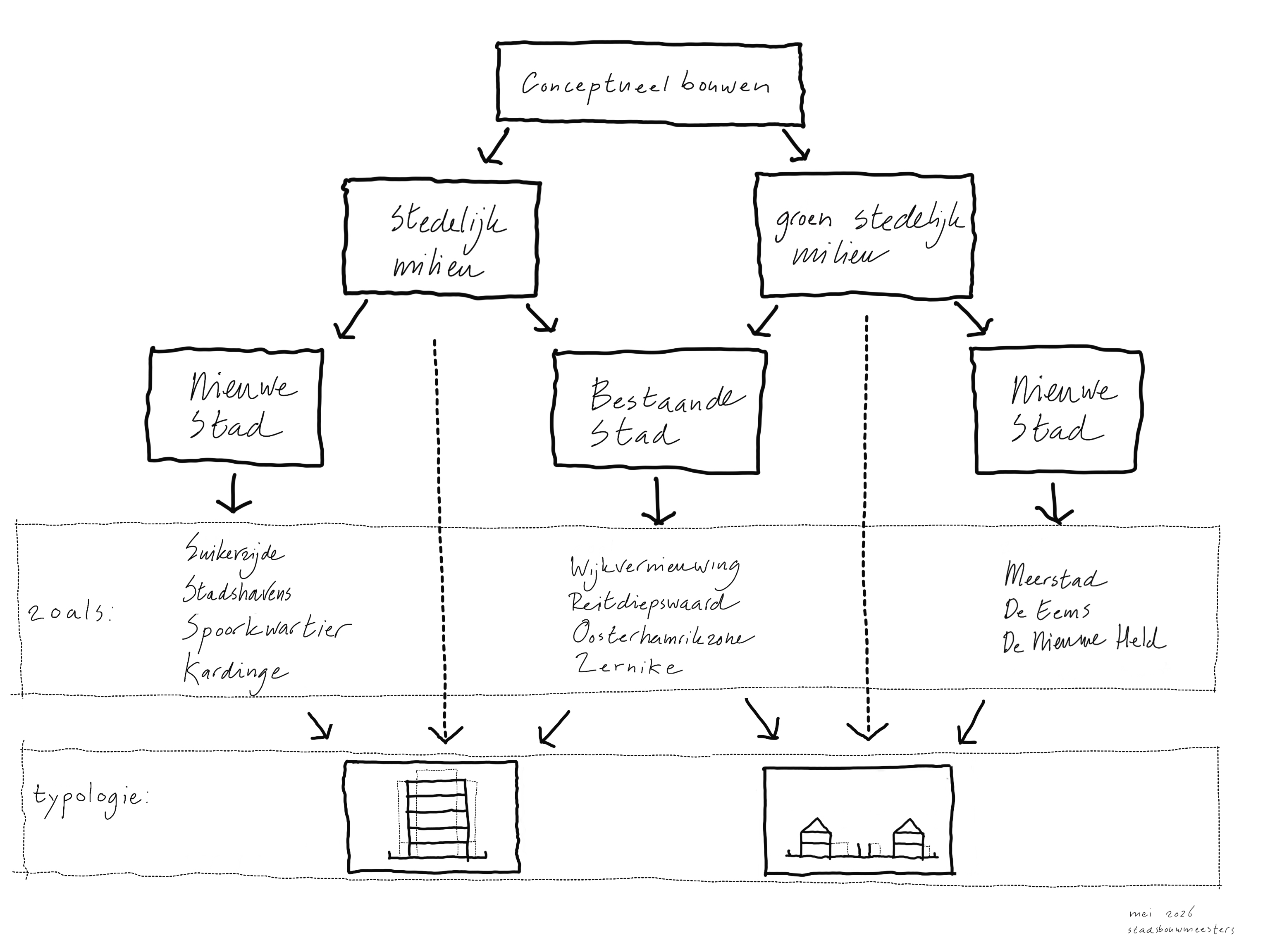
The city as a template, not the system
One of the key insights from the essay is that the term ‘conceptual building’ is too often used as a one-size-fits-all, generic solution that can simply be rolled out anywhere. In practice, however, the situation is far more complex. According to Ben and Michiel, the finest and most sustainable projects only come about when the context of the site takes precedence.
“As long as we start with the building system rather than the city, we may build faster, but not better.”
Whether it involves the regeneration of existing neighbourhoods or large-scale new urban developments, the physical and social environment must always be the starting point. Only when urban planning, architecture and the building system are designed in an integrated manner from day one can true quality be achieved.
Six principles for spatial quality
To truly take housing development in Groningen to the next level, the city architects set out six clear principles in their essay:
-
Start with the city, not the system: Urban planning parameters and frameworks must be designed in interaction with the logic of the factory.
-
Design the urban development and the factory simultaneously: Bring the urban planner, architect, engineer and builder together at the drawing board right from the very start.
-
Always work in cross-disciplinary teams: Collaboration from the outset ensures that the practical value, experiential value and future value are safeguarded at every level of scale.
-
Maintain hybrid construction as a tool for quality: Combine factory-made basic elements with traditional techniques or innovative façade systems to achieve greater character and architectural freedom.
-
Embed design quality into the brief: Design costs are not a mere expense, but a crucial investment in the quality and ongoing development of effective systems.
-
Restore the guiding role of public housing and housing associations: Make housing associations structural partners with multi-year programmes at the design stage.
Fancy reading the full essay?
We are immensely proud of the substantive contribution Ben is making, in his independent capacity, to the future of urban development in Groningen. The essay is intended as an inspiring guide for everyone involved in the construction sector – from housing associations and developers to designers and decision-makers. Hopefully, it will challenge many to take a fresh, holistic look at our built environment, so that together we can continue to build places that really matter.